Efficacy of commercial disinfectants Virkon®S and Microchem Plus against poliovirus
FAYETTEVILLE, GA, UNITED STATES, September 21, 2026 /EINPresswire.com/ -- The WHO Global Action Plan for Poliovirus
Press Release Disclaimer: This is a press release distributed through the XPR Media network. It has not been independently verified by our newsroom.
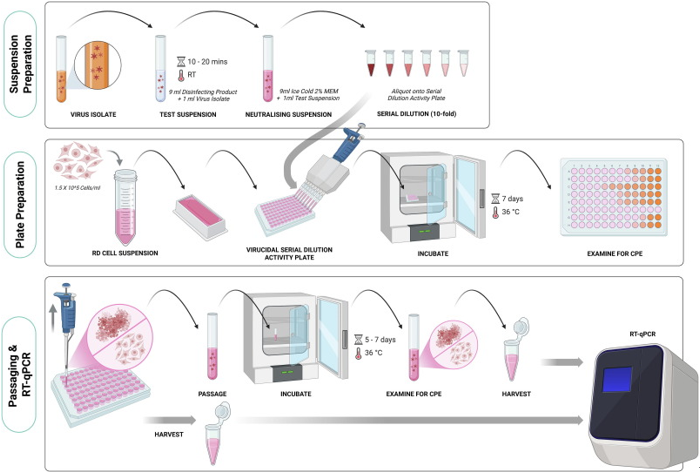

FAYETTEVILLE, GA, UNITED STATES, September 21, 2026 /EINPresswire.com/ — The WHO Global Action Plan for Poliovirus Containment, 4th edition (GAPIV) describes the necessary conditions for the containment of poliovirus material in poliovirus-essential facilities (PEFs). The method used for validation of chemical products for poliovirus decontamination in this study was based on processes outlined in European Standard EN14476, as recommended by the WHO GAPIV guidelines. The disinfectants 5 % Microchem Plus and 1 % Virkon®S were evaluated for efficacy against high titre poliovirus in solutions with and without high organic load using an endpoint dilution assay. A poliovirus Sabin 1 strain was used as the reference virus with the titre 8.33 log10 CCID50 (50 % cell culture infectious dose) in 0.1 ml. Microchem Plus only partially inactivated poliovirus and cannot be relied upon as the sole decontaminant. In contrast, Virkon®S performed well for both high titre poliovirus in solutions with and without high organic load, achieving >4 log10 titre reduction for both, making Virkon®S a suitable disinfectant for poliovirus.
The WHO 4th Global Action Plan for Poliovirus Containment (GAPIV) mandates poliovirus-essential facilities (PEFs) to validate on-site decontamination protocols for non-enveloped poliovirus, a pathogen resistant to many routine disinfectants. A study published in the Journal of Biosafety and Biosecurity assessed two commercial biosecurity disinfectants—5% quaternary ammonium compound (QAC) Microchem Plus (20 min contact) and 1% oxidizing Virkon®S (10 min contact)—per European standard EN14476, using Sabin 1 poliovirus stock at an initial titre of 8.33 log₁₀ CCID₅₀ per 0.1 mL.
Tests included pure high-titre virus (HTV) and virus-spiked faecal suspension simulating high organic load (HOL); infectivity was measured via RD cell cytopathic effect (CPE) and confirmed by enterovirus RT-qPCR.
Microchem Plus only partially inactivated poliovirus. After 20 min treatment, residual virus titre reached 5.5 log₁₀ CCID₅₀, equalling merely a 2.8 log₁₀ reduction—far below the ≥4 log₁₀ threshold required for PEF disinfection. Secondary cell passaging and RT-qPCR both detected viable viral RNA, proving persistent infectivity. Consistent with prior research on another QAC disinfectant Cavicide, QACs show weak activity against non-enveloped enteroviruses like poliovirus, so Microchem Plus cannot serve as a standalone decontaminant for PEFs.
In contrast, 1% Virkon®S achieved full viral suppression meeting official efficacy criteria. For HTV samples, viral titre dropped to ≤1.5 log₁₀ CCID₅₀ (≥6.8 log reduction); under heavy organic interference (HOL), it still delivered a ≥5.8 log titre cutback. No CPE or amplifiable viral RNA was recovered after two rounds of cell culture, indicating near-complete viral inactivation at the assay’s detection limit.
Notably, as a peroxygen-based broad-spectrum disinfectant, Virkon®S retains potency amid organic matter, is less corrosive and toxic than bleach, formaldehyde or glutaraldehyde, and works against analogous enteroviruses such as EV-A71.
Nonetheless, limitations exist for Virkon®S: its working solution expires within five days after preparation, and long-term exposure may mildly corrode metal. It suits bench surfaces, small labware and spill cleanup but is unsuitable for immersion tanks and chemical showers. For facilities relying on such equipment, combined disinfection workflows are recommended.
In conclusion, Microchem Plus fails to fully neutralize poliovirus and is unfit for exclusive PEF decontamination, whereas Virkon®S meets international standards for poliovirus inactivation with or without organic contamination, offering a reliable disinfection option for poliovirus containment laboratories to shape biosafety protocols.
References
DOI
10.1016/j.jobb.2025.08.002
Original Source URL
https://doi.org/10.1016/j.jobb.2025.08.002
About Journal of Biosafety and Biosecurity
The Journal of Biosafety and Biosecurity is an open access journal that publishes research articles, short communications, event reports, opinions, letter to editors, reviews and editorial comments in all aspects of biosafety and biosecurity, including laboratory management and infectious disease which could threat social stability. The objective of this journal is to promote global biosafety and biosecurity awareness and facilitate the development and appropriate practices.
Lucy Wang
BioDesign Research
email us here
Legal Disclaimer:
EIN Presswire provides this news content “as is” without warranty of any kind. We do not accept any responsibility or liability
for the accuracy, content, images, videos, licenses, completeness, legality, or reliability of the information contained in this
article. If you have any complaints or copyright issues related to this article, kindly contact the author above.

Media gallery